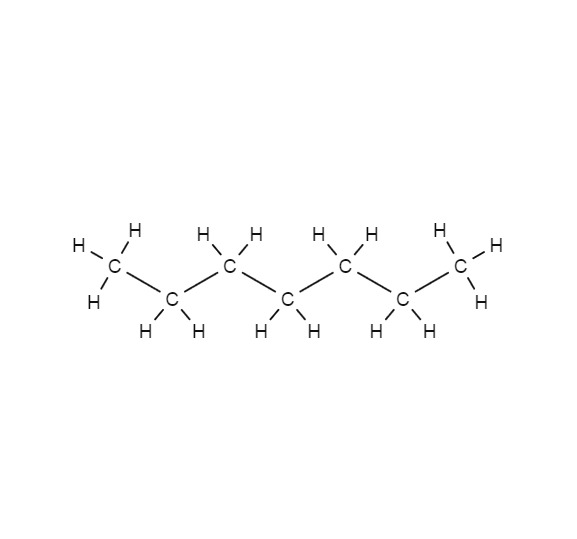
n-Heptane
- C7H16
- CAS Number 142-82-5
- UN1206 (gas)
Click & drag to move the 3D molecule
Liquid / Gas Volumes
Calculate the volume or mass of a quantity of gas or liquid
Liquid Phase
At boiling point at 1.013 bar
Gas Phase
In standard conditions (1.013 bar, 15°C)
Physical Properties
Molecule phase diagram showing the transition phases between solid, liquid and gas as a function of temperature and pressure
-
- Molar mass 100.202 g/mol
- Content in dry air /
-
Critical Point
- Temperature 267.05 °C
- Pressure 27.4 bar
- Density 234.12 kg/m³
-
Triple Point
- Temperature -90.60 °C
- Pressure 1.827E-6 bar
Pressure 1.013 bar
| Latent heat of fusion (at melting point) | 140.217 kJ/kg |
| Melting point | - 90.58 °C |
Pressure 1.013 bar
| Boiling point | 98.38 °C |
| Latent heat of vaporization (at boiling point) | 316.887 kJ/kg |
| Liquid density (at boiling point) | 614.219 kg/m3 |
Applications
Examples of uses of this molecule in Industry and Healthcare
Safety & Compatibility

GHS02
Flammable

GHS08
Serious health hazard

GHS09
Hazardous to the environment
Autoignition Temperature, Flammability Limits & Flash Point
Europe (according to EN1839 for Limits and EN 14522 for autoignition temperature)
| Autoignition temperature (Chemsafe) | 220 °C |
| Lower flammability limit (IEC 80079-20-1) | 0.84 vol% |
| Upper flammability limit (IEC 80079-20-1) | 6.7 vol% |
US (according to ASTM E681 for Limits and ASTM E659 for autoignition temperature)
| Autoignition temperature (NFPA 325) | 204 °C |
| Flash point (NPFA 325) | - 4 °C |
| Lower flammability limit (NFPA 325) | 1.05 vol% |
| Upper flammability limit (NFPA 325) | 6.7 vol% |
Threshold of toxicity
| ILV-8h EU (at Patm and 293.15 K) | 2085 mg/m3 or 500 ppm |
| PEL USA OSHA (vol) | 500 ppm |
| VLEP 8h France (at Patm and 293.15 K) | 1668 mg/m3 or 400 ppm |
| VLEP CT France (at Patm and 293.15 K) | 2085 mg/m3 or 500 ppm |
Odor
Gasoline
Metals
| Aluminium | No data |
| Brass | No data |
| Monel | No data |
| Copper | No data |
| Ferritic Steel | No data |
| Stainless steel | No data |
| Zinc | No data |
| Titanium | No data |
Plastics
| Polytetrafluoroethylene | No data |
| Polychlorotrifluoroethylene | No data |
| Polyvinylidene fluoride | No data |
| Polyvinyl chloride | No data |
| Ethylene tetrafluoroethylene | No data |
| Polycarbonate | No data |
| Polyamide | No data |
| Polypropylene | No data |
Elastomers
| Butyl (isobutene- isoprene) rubber | No data |
| Nitrile rubber | No data |
| Chloroprene | No data |
| Chlorofluorocarbons | No data |
| Silicone | No data |
| Perfluoroelastomers | No data |
| Fluoroelastomers | No data |
| Neoprene | No data |
| Polyurethane | No data |
| Ethylene-Propylene | No data |
Lubricants
| Hydrocarbon based lubricant | No data |
| Fluorocarbon based lubricant | No data |
Materials compatibility
Learn More
More information
Heptane is one of the 9 isomers C7H16 or a derivative of these molecules that comprises 7 atoms of carbon. In greek, "ἑπτά" (epta) means "seven".